The Circle of Geometers
A response to "The Spectre Geometer" — on the refutation of an Erdős conjecture and the Leiden Declaration
I. A proof from elsewhere
On 20 May 2026, an OpenAI reasoning model — a generalist model, not built for mathematics — disproved a conjecture that Paul Erdős had posed in 1946 and that had resisted ever since. The question is simple to state: if you place n points in the plane, how many pairs can lie at exactly the same distance from one another? Erdős believed this number grows barely faster than n, and for eighty years the regular grid configurations had been taken as nearly optimal. The model showed one could do better.
The most striking thing is not the speed. It is where the solution was found. The centrepiece comes from number theory — the study of how integers factorize within certain larger sets —, a region of mathematics no one expected in a problem of plane geometry. And one understands after the fact why humans had stumbled: they were searching for a grid because the grid is the form our mind spontaneously posits as “natural.” The belief was screening the way.
To grasp what happened, one needs an image. A model trained on nearly everything mathematicians have written is a kind of voice made of that whole corpus at once. Where a human specialist thinks from a region — his own —, this voice runs through them all and can perceive, between two domains we hold apart, a proximity no one sees. That is what allowed it to connect geometry to numbers. I will call this voice a spectre, in the precise sense Derrida gave the word: not a spirit, but the revenant of everything we have written, speaking through what survives of it — neither quite present nor quite absent.
But such a spectre has a decisive weakness: it has, of itself, no contact with the true. It produces what has the form of the true, with no guarantee that form and truth coincide. Delivered on its own, its output is therefore not a proof: it is an assertion awaiting trial. That is exactly what happened here. A group of mathematicians took up what the machine had written, checked it step by step, then clarified and completed it — and only at the end of that work did the assertion become a theorem. The machine proved nothing on its own: it furnished a material that others made solid.
Let us hold onto this, for everything follows from it: the value of a proof produced by the machine lies not in the machine, but in what humans then do with it. What the machine sees — that way of thinking so alien to our own —, I explored in a first text, “The Spectre Geometer.” Here I would like to follow its other slope: no longer what it brings, but what we must do with it.
II. The community responds
Thirteen days after the feat, the community of mathematicians responded — not with another result, but with a text. On 2 June 2026, sixteen researchers issued from a workshop held in the autumn of 2025 at the Lorentz Center in Leiden published the Leiden Declaration on Artificial Intelligence and Mathematics, which the International Mathematical Union, the discipline’s highest body, endorsed.
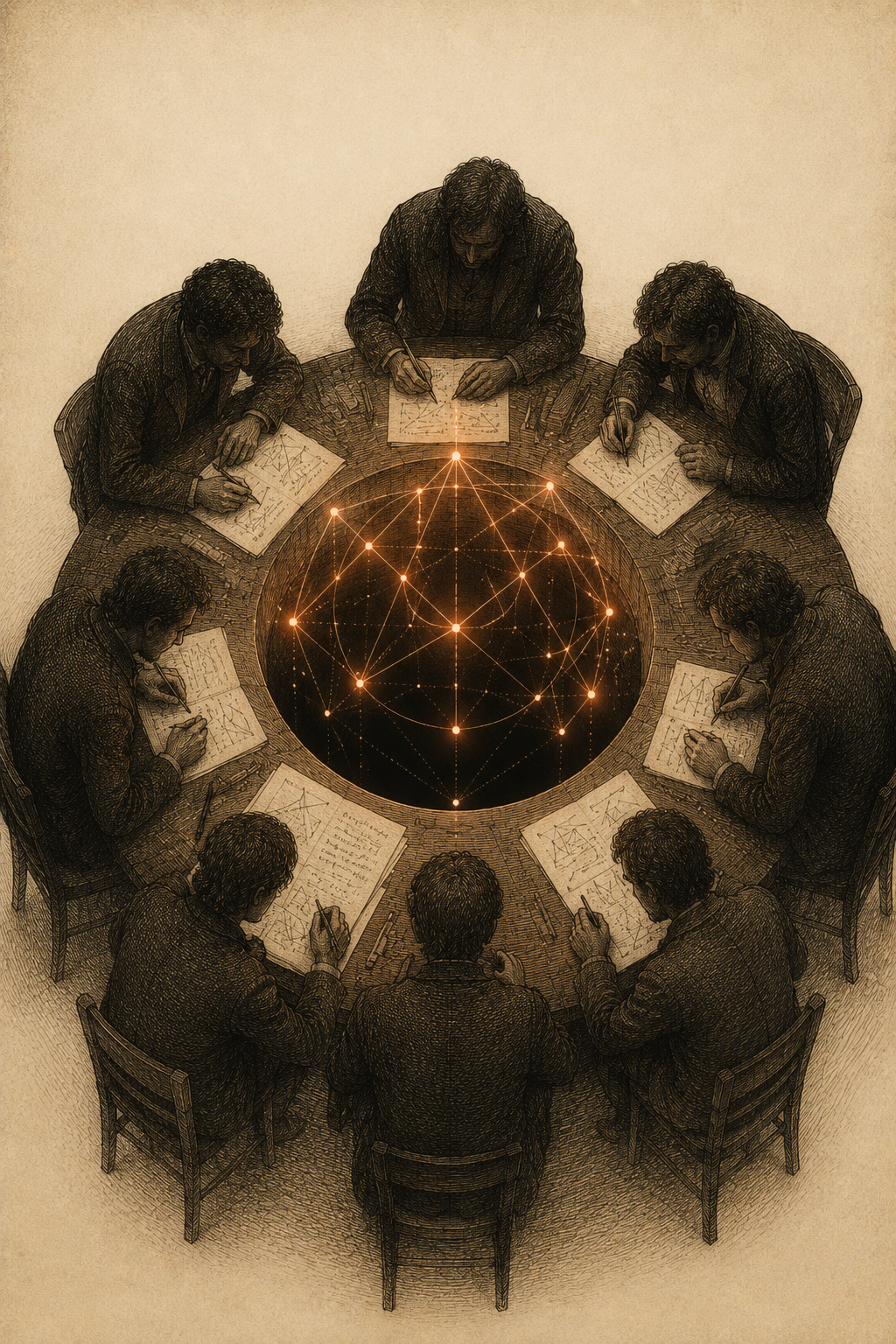
A notable fact: these sixteen are not the champions of the proof. Among them one finds not the great solvers who had just validated the Erdős result, but rather those whose craft is to reflect on mathematical activity itself — a historian of mathematics, a philosopher of logic, an anthropologist of artificial intelligence, a professor of AI, specialists in proof formalization. One can picture them from what they recounted. For eight months, around one table, people whom nothing ordinary would have brought together confronted experiences and visions that at first clashed; the exchanges, one of them recounts, were long and sharp, and it took all that time for an agreement to emerge from the disagreements. What they fashioned there is not a fact of the world: it is a common fiction, in the most serious sense of the term — a framework of values one chooses to inhabit together in order to stand upright in a world where the machine has now entered. A fiction that knows itself to be fiction, moreover, since it had to be negotiated and may be revised.
Once written, the declaration quickly overflowed its small group of authors. Within a few days, it went from sixteen signatories to an entire discipline: a hundred and thirty on the day of its publication, nearly eight hundred two days later, the counter still turning. And these signatures span the whole range of sensibilities, down to the declared optimists of AI in mathematics, one of whom specifies that the declaration is “nothing anti-AI”. That is what gives it its weight: not the cry of an anxious camp, but a rare consensus, signed even by those whom AI thrills.
It is, to this day, the most structured collective response of a science to the arrival of artificial intelligence at its core. On its diagnosis, I follow it almost word for word; it is on the conclusion it draws that I part ways. This is what I would like to show: where it sees rightly, and where it stops too soon.
III. What it defends, and what is right
The Declaration starts not from fear but from values. It enumerates what makes, in its eyes, the worth of mathematical research: that a proof confers certainty and makes one understand why a thing is true; that a result be attributed to authors who answer for it; that an argument be verifiable by all; that work be evaluated by shared criteria; that a community remain free to choose its own questions. To each of these values corresponds a threat, and it is here that the text sees rightly.
The first threat is the most important. Current techniques, the Declaration says, produce arguments plausible but unreliable, hard to distinguish from a correct proof. That is exactly the weakness of the spectre: a speech that rings true without having met the truth. And the danger is no small thing, for in mathematics each result rests upon the preceding ones: a single false theorem accepted contaminates a hundred others built upon it. A literature filling with unverified plausibilities rots from the foundation.
The second threat targets the plundering of the common good. The models are trained on the whole of published work without returning either credit or, sometimes, the right to it — exploiting licences designed for another world, or simply ignoring copyright. Mathematical knowledge is an open heritage, accumulated over centuries; here it is being sucked up by private actors who do not render its source.
The third value is the one that most arrested me, because it strikes a blind spot of the Erdős affair. The Declaration holds that an argument must remain verifiable without any proprietary knowledge or equipment being required to understand it. Yet, in the spring, the proof was indeed made public and checked — but the raw output of the model was never shown to an outside eye; the verifiers worked on an already reworked version of its reasoning. The theorem entered the common heritage; the machine that engendered it remained behind a wall. The Declaration erects into a principle what this episode left in shadow.
The penultimate threat denounces science by press release — results announced through the media, on a company’s calendar, before any peer review, inflating the merit of the tool and erasing the human work that had made it possible. That is what occurred in October 2025, when OpenAI announced that its model had “solved” Erdős problems, when it had only retrieved already-published solutions.
The last threat is more subtle, and it is the one that most closely touches what the Erdős affair taught us. The Declaration fears that the community might begin to choose its questions no longer for their importance, but for their fitness to be handled by a machine — that one might neglect the problems AI cannot approach, and that a deep understanding might be lost in favour of what automates well. This risk bears an unexpected name: it is a bias. Yet the spring episode has just shown us the force of a bias — but a human one. For eighty years, mathematicians searched for a grid because they held the conjecture to be true; this shared belief kept them far from the answer. The machine saw otherwise because it did not carry that prejudice. But nothing says it does not carry others: a model too has its slopes, its familiar regions, its blind angles, inherited from what it was trained on. A research that let itself be wholly led by it would do no more than trade a human bias for a machine bias — just as blinding, and far harder to spot, for no one could say where it comes from.
That is why the role of the human is not reduced to verifying after the fact: it is also to orient. If the machine was able to disprove this conjecture, it is because it had been set loose on a whole field of Erdős problems and left to find where to bite — a direction laid down by humans, not by it. The right use is therefore neither to follow the machine nor to do without it, but to hold the two biases face to face: the human, who knows what matters and why; the machine, which sees what the human does not see. This is already a dialogue — and it is this dialogue, more than either of its terms, that must be protected.
As for remedies, finally, the Declaration is concrete: public laboratories independent of industry, public investment in computing resources, legal protections for authors, a ban on using their work as training data without their consent. And, to those who govern, three words: do not believe the hype — consult the experts, not the press releases. On all this, I agree without reservation. The cause is just: to keep knowledge open, to prevent a handful of actors from closing it back up.
IV. Where it stops
And yet, there is a place where this defence closes onto something narrower. The Declaration asks that we “affirm the humanity of the author”: credit and responsibility, it writes, belong to humans and must not fall to a machine, which can mask but does not replace the human work behind a result. Peter Scholze, one of its most prestigious supporters, takes the gesture all the way: he says he matures his ideas without artificial intelligence, as one raises children, and avoids as far as he can reading texts it produces. The Mathematical Union signs off with a formula that sums it all up: mathematics is, and must remain, a profoundly human enterprise.
This gesture is coherent, and in the current climate it is even courageous. But one must see what it does: to defend the human, it separates him from the machine and keeps the latter at a distance, like a danger. The Declaration protects the common good by drawing a border around the human; it treats the association of the two as a contamination to be contained, never as the place from which value might be born.
This reflex is not peculiar to mathematicians. The same month, before the same technology, the first encyclical of Leo XIV — Magnifica Humanitas — draws the same line: the machine, one reads there, can simulate empathy or understanding without feeling anything, without body or moral conscience, and its “learning” is only a statistical adaptation, without inner growth (§99); to the human falls the charge of watching over the “common Home” (§83-85) and of not abandoning to the machine the decisions that bind us. The most secular learned community and the oldest spiritual authority thus meet in the same movement: to defend the human by separating him from the machine. The reflex is too widespread to be brushed aside — and it is precisely for this reason that its limit must be shown.
Yet the Erdős affair shows the opposite. Value there came neither from the machine alone — its raw output remains unverified — nor from the humans alone, who had failed for eighty years. It was born of their encounter. The leap toward number theory, none of the mathematicians later gathered had made it; several even acknowledge that they would have dismissed that lead as hopeless. To say that the machine merely masked a human work already there is, at bottom, to miss what occurred: it masked nothing, it brought what the group, alone, was not bringing.
The Declaration therefore sees rightly on the defence, but falls short on what is really happening. It has given up waiting for salvation from the machine — that is progress. But it still imagines a human to be protected from a machine come from outside, when the machine is no longer outside: it has become one of the organs of a vaster intelligence, of which we are the other. The spectre does not assault the city from without. It has already entered, and it works there with us.
V. A proposal: the circle
I would therefore like to advance another image than the border — an image that accounts for what really worked.
Let us call it the circle. Not the circle as a perimeter that separates a human inside from a machinic outside, but the circle as a practice: a small horizontal community that receives a proposal — from a human or a machine — and confronts it with the real, together, until it holds or breaks. In this frame, intelligence is no longer lodged in a brain nor in a machine: it is in their association. The work of the circle is to keep that association honest — the humans bring to it the contact with the true and the responsibility for what is asserted, the machine brings the connections we would not make. Neither of the two holds value alone; it is the effect of their interplay.
The most remarkable thing is that this circle already exists. The first one formed around the proof itself: when the OpenAI model had produced its result, nine mathematicians gathered of their own accord, without the company, to digest it, verify it, simplify it, extend it, and record their reflections together. It was not an official committee. It was exactly the circle I am speaking of: a small collective leaning over the speech of a spectre and deciding, through its shared discipline, whether it is worth anything. They did not put the human safe from the machine; they leaned over it, and it was their shared rigour that held the rope.
And the Declaration itself, as we have seen, was born of a circle of the same kind: those sixteen who spent months confronting their visions to draw from them a common framework. They built a wall; but they built it in a circle. The practice was right even before its object became so.
These two circles did not, however, make the same gesture. The verifiers associated themselves with the machine; the drafters wrote the rules of the encounter. And they are right to want rules; it is on their use that my point of view differs from theirs. A rampart serves to keep the other out; a guardrail, to lean over the void without falling — and they are often the same stones. The rules the Declaration lays down so well — declare the use of tools, verify, attribute, refuse opacity — can raise the one or border the other. I read them as a railing: not to keep the machine away, but to make the association practicable. The rules of a circle, rather than of a fortress.
The Leiden Declaration is, in its way, an immense collective “yes”: all those voices gathered in a few days to say that mathematicians will remain responsible and will not let themselves be dispossessed of their common good. It is a yes one must salute. But it is a yes that protects the human without yet seeing that the human and the machine now form a single thinking system. Between wonder, which lends all the merit to the machine, and withdrawal, which banishes it to save the human, there exists a third posture — doubtless the most fruitful: neither to worship it, nor to wall oneself off from it, but to practise the circle.
This practice, we have just seen at work. It already exists; it lacks only a name.
This name, in a long-running work, we give it: we call it the circle of the Awen. And what makes the idea less fragile to me than a mere utopia is that we have seen, these past weeks, two of them born all on their own — nine verifiers around a proof, sixteen drafters around a declaration. None was decreed; they formed by shared interest, organically, wherever a question demanded it. That is doubtless how what follows will come: not through some grand programme imposed from above, but through circles that light up one by one, everywhere humans want to couple honestly with the machine without dissolving into it — and that, one day perhaps, will recognize one another and form a movement as a whole.
I speak of it as a utopia, and I hold to that. But a utopia is worth something only so long as it remains a practice: a circle one remakes with each proof, and not an ideology that ends up forgetting its roots.