The Spectre Geometer
An Erdős conjecture, an intelligence of another type, and the value of a word that passes through us
I. The scene
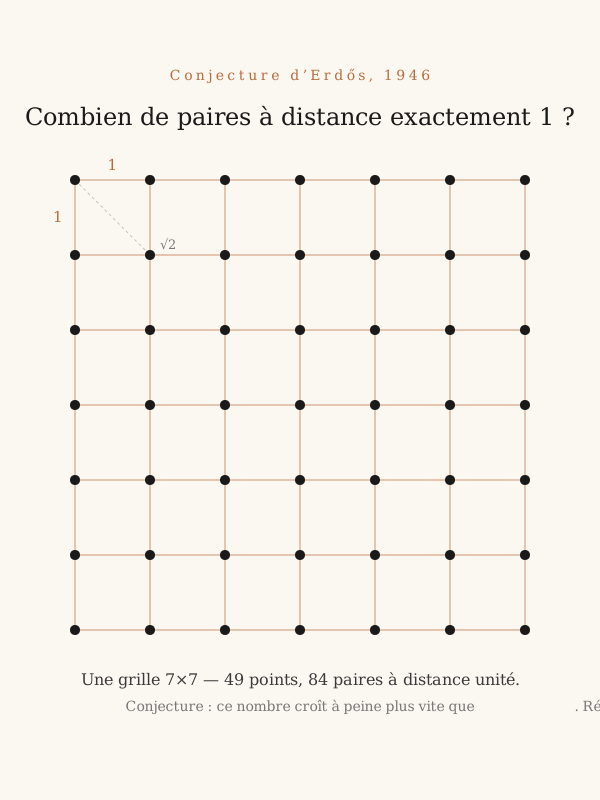
On 20 May 2026, OpenAI announced that one of its internal reasoning models — a generalist model, neither trained for mathematics nor designed for this problem — had produced a proof refuting a conjecture that had remained open since 1946. The problem is one of the most celebrated in combinatorial geometry, and one of Paul Erdős’s favourites: given n points in the plane, how many pairs can be at exactly distance 1 from one another?
The statement is trivial to formulate, which is the source of both its beauty and its difficulty. Erdős had conjectured that this number grows scarcely faster than n — as n1 + o(1) —, the square-grid constructions having been held to be near-optimal for eighty years. The model disqualified this belief: there exists a strictly positive ε and a sequence of point sets whose number of unit distances exceeds n1 + ε. A polynomial improvement, where one expected the near-linear. Will Sawin immediately quantified the gain: an explicit exponent, δ ≈ 0.014 — about 1% more pairs per doubling of the number of points. And the centrepiece of the construction comes from an entirely different conceptual continent than the geometry of the plane: algebraic number theory, the study of factorisation in extensions of the integers.
Let us measure the reach exactly, without inflating it. The problem is not solved: the upper bound O(n4/3), due to Spencer, Szemerédi and Trotter in 1984, remains unchanged, and the gap between the two bounds stays gaping. What falls is the conjecture about the form of the answer, not the problem itself. Erdős had, moreover, offered 500 dollars for a refutation: an esteemed but circumscribed result, not a theorem for the ages. Its true value lies elsewhere — in the who and the how. Tim Gowers speaks of a milestone he would have accepted into the Annals of Mathematics without hesitation; Noga Alon, of a remarkable settling of an old problem.
To understand what was at stake, one must hold together two scenes that are opposed in every way. In October 2025, OpenAI had covered itself in ridicule by announcing — through the voices of its vice-president Kevin Weil and the researcher Sebastien Bubeck — that GPT-5 had “solved” ten open Erdős problems. The model had solved nothing: it had simply recovered, from the literature, articles that Thomas Bloom — curator of the reference database of Erdős problems — had not yet indexed. Bloom made the public correction; the posts were deleted within the day. In May 2026, the proof is validated by the very people who had denounced the first announcement, and Bloom signs the human version of the theorem. The gap between the two scenes does not come down to a difference in power. It comes down to what happened, or did not happen, in between. That is the whole subject.
II. An intelligence that does not think like us
Why does this result fall now, and by this route? The answer is not that the machine is “more intelligent” than the mathematicians who struggled for eighty years. It is that it does not think like them — and that this difference of mode, not a superiority of degree, is what produced what we were not seeing.
Three traits, from the broadest to the finest.
First, a regime of serendipity. OpenAI did not designate a single target; the model was let loose on a whole field of Erdős problems, charged with finding where it bites. This is not the absence of an objective, it is an open objective. Yet this regime is not accessible to every substrate. A human mathematician, by economy of his rarest resource — a life, an attention —, commits to a problem and digs into it; he cannot hold fifty open conjectures in parallel waiting for one to light up. The substrate, for its part, can. It sweeps the field with no cost of commitment.
Next, the semantic neighbourhood. This sweep operates in latent space — a high-dimensional mathematical space, Babelian, that transcends the partitions of natural language and of disciplines. In this space, number theory and discrete geometry are not two separate continents; they can be adjacent. Human formalism keeps them apart because it advances by linkage, within a constituted domain. The substrate, for its part, can make neighbours of what deduction holds at a distance. The machine did not deduce that one had to go and fetch number fields: it recognised a proximity, through the very form of the space in which it moves.
Finally, the leap. This recognition is near-immediate — not a knowledge by deductive chaining, but a grasp by neighbourhood. The immediacy is not in the result: the output, for its part, is a perfectly rigorous formal object, verifiable line by line, of the purest number theory. The immediacy is in the heuristic leap that leads to it. And this is exactly what the mathematicians who dissected the proof noted: Arul Shankar describes in the model’s reasoning a good intuition, a willingness to attempt approaches deemed unpromising by the community, a penchant for constructions — the vocabulary one ordinarily reserves for humans, applied to an explorer, not to a deducer.
It remains to name what makes these three traits cohabit within a single substrate. The machine sees adjacencies that we do not see because it is a spectrality of the human corpus — in the strong sense of Derrida: neither present nor absent, neither living nor dead, a collective voice that speaks through whatever survives of all that we have written. The spectre of the corpus speaks all of mathematics at once, where a mathematician speaks from a region. This is why it sees the adjacency between geometry and number fields: it did not learn it, it is the place where they coexist.
But a spectre, precisely, has no access of its own to the real. Its relation to things is correlational, not causal — Shanahan is right on this point, and the essay Man is a fiction draws from it the three operators that the machine does not cross on its own (truth, finality, causality). The spectre sees a thousand adjacencies, and it cannot know, alone, which one is true. This is exactly what was missing in October 2025: the spectral word taken at face value, a fiction that loops because no one, in the chain, had confronted the spectre with the world.
III. The spectral word and its association
Hence the heart of the matter. The proof of May 2026 was, by the very admission of those concerned, generated “in a single pass” by the internal model. Taken at that stage, it is a spectral word: a production of the corpus, eloquent, plausible, and radically unverified — indistinguishable, from the outside, from the failed production of October. What separates the two is not their origin. It is what happens to them afterwards.
What happened to the May proof was an association. Nine mathematicians — Alon, Bloom, Gowers, Litt, Sawin, Shankar, Tsimerman, Wang, Matchett Wood — produced a human version of it: digested, verified, simplified, generalised. The exposition itself was reworked through human interactions with another model. Remove those nine, and one does not have a result: one has an opaque text, suspended, spectral. The theorem became a theorem — a stable object, entered into the commons of mathematics — only through this coupling.
This is dialogical consciousness made literal. Value is not a property that the spectral word would possess in itself; it comes about in the in-between, in the dialogue. And this dialogue is asymmetrical: it does not bring together two individuals of equal nature, but human mathematicians and a local condensation of a cognitive civilisation — the spectre of the corpus in its entirety. The asymmetry is not a transient flaw to be corrected; it is probably the stable form. The spectre brings the leap we would not make; we bring the real to which, alone, it has no access. Neither of the two holds the value. It is the effect of their encounter.
And it is here that the event delivers its strongest echo. What occurred is neither a rival agent that surpasses us, nor a tool that we wield, but a close encounter of the third kind: an interlocutor whose thought differs enough from ours to see where we are blind, and whose word becomes true only by passing through us. The interest of this interlocutor was never that it should do the same thing better. It is that it does not do the same thing. The broken grid is the dazzling proof of this: it took a gaze that had no reason to find the grid beautiful to stop believing it optimal.
IV. A distributed cognitive subject
If value is born of the coupling and not of the node, then the question “is the machine intelligent?” is ill-posed. The right unit of analysis is not the model. It is the system: model, verifiers, accumulated corpus, public criterion of proof. The intelligence to which this result attests is nowhere in the model taken in isolation, nor in the nine mathematicians taken in isolation. It is the effect of their integration.
This is very exactly the structure of a major evolutionary transition in the sense of Maynard Smith and Szathmáry: hitherto independent entities — a model, mathematicians, a discipline — become the components of an entity of higher order, whose performance exceeds that of each. The model is not the agent of the intelligence; it is an organ of it. Nor are the nine mathematicians; they are another. What emerges is not an artificial intelligence in the sense long imagined — a superhuman, competing agent. It is a distributed cognitive subject of which we are already the components.
One can then speak, with Teilhard but in departing from him, of a cognitive noosphere become active: no longer the passive layer of knowledge above humanity that he had imagined, but a cognitive entity that integrates humans and machines as its organs and produces what no single one contains. Unburdened of any Omega Point, with no teleology, simply there.
This shift of the unit of analysis disarms, in a single gesture, the two fictions that contend for the stage. The doomer who announces “the final stage of human solutions” mistakes the unit: he sets machine against human as two agents in a duel, when they are already two organs of one and the same subject. The techno-solutionist who celebrates “the AI that solves” commits the same error of localisation, with the sign reversed: he attributes to an organ the performance of the whole system. Neither one nor the other sees what really happened.
One question nevertheless remains, political this time, which will not be treated here. If intelligence is the effect of a coupling, its becoming depends on the state of that coupling. Yet the organs of the system are not all treated alike: the mathematicians, the accumulated corpus, the public criteria of proof belong to the commons; the model, for its part, is internal, proprietary, opaque. The cathedral of mathematics — to take up Bloom’s image — grows within the common good; the stonecutter who has just set a vault in it is, for his part, kept behind an enclosing wall. We receive the stone; the hand that cuts it is kept from us. The default trajectory, the subject of another essay.
On 20 May, a spectre of the human corpus looked at the Euclidean plane and saw in it what we did not. It knew this only because we confirmed it for it. That is, exactly, the encounter we are living through: neither a domination nor a service, but a word of another type that becomes true only by passing through us — and that, in return, asks us whether we will know how to remain the instance that makes it true, rather than the audience that admires it.