Systemic Closure
Five layers, a single movement — the week we watch the loop closing in on itself
I. The image and the argument
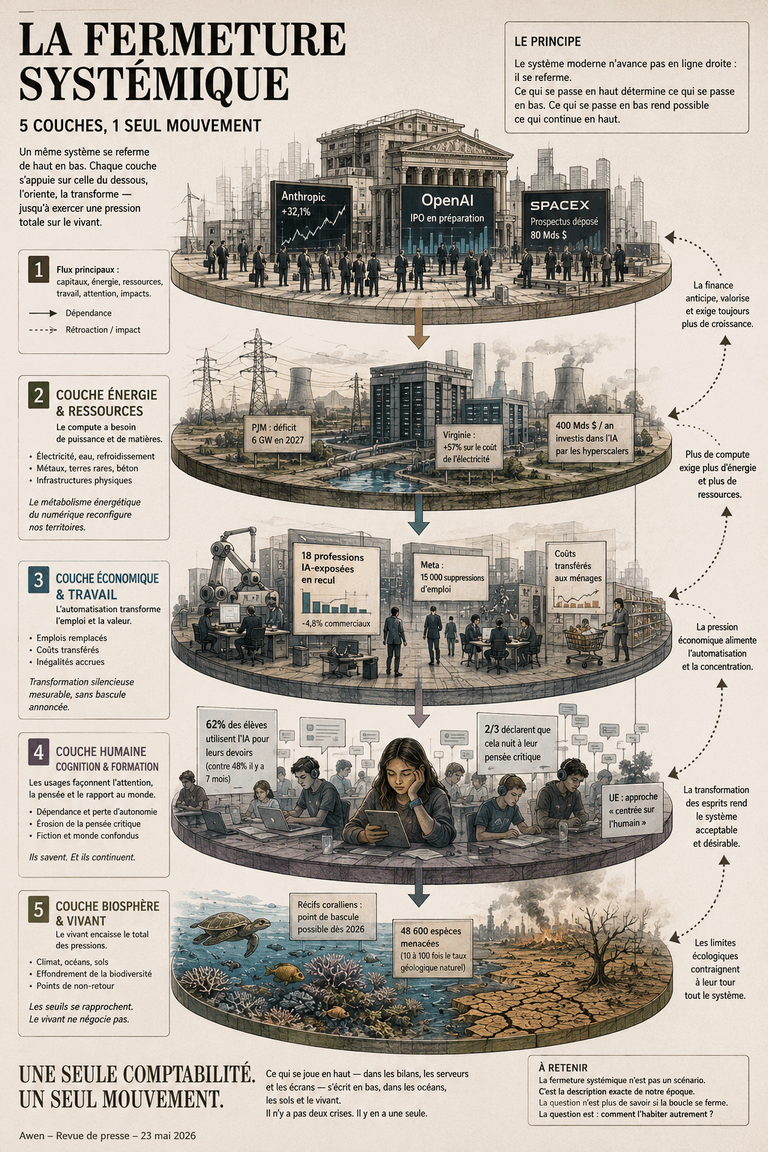
The illustration heading this piece is not a topical sketch. It is the argument. Five storeys — financial layer at the top, energy/material layer, economic layer of labour, human cognitive layer, layer of the living — stacked along a downward arrow that runs from each tier to the next. The modern system, the caption says, does not advance in a straight line: it closes in on itself. What happens at the top determines what happens at the bottom. What happens at the bottom makes possible or impossible what continues at the top.
Read in isolation, each piece of news from the week of 18 to 23 May 2026 files itself into the folder usually assigned to it: technology finance, energy policy, the sixth extinction, the labour market, digital pedagogy. But these are five folders that published, on the same Saturday, their respective stock-takings. And read together, they sketch something else: the outline of a single five-storey edifice, in which each tier depends on the one before and conditions the one after. The silent transformation that the manifesto speaks of no longer needs to be demonstrated through historical analogies. It has begun to publish its own weekly reports.
Five layers, then. Here is how they move — and why they move together.
II. The financial layer moves up a notch
Three announcements from the same Friday, 22 May, sketch the industrial shift: Anthropic declares itself on track for its first operationally profitable quarter, with projected Q2 revenue of $10.9 billion; OpenAI is preparing to confidentially file its IPO prospectus with the SEC; SpaceX files the largest prospectus in stock-market history — $80 billion — with, folded inside it, a chatbot business and $6.4 billion in AI-related losses. Three companies that, together, will finance the deployment of what this site calls the cognitive noosphere — now valued, traded, owned by millions of retail investors through their brokers.
The shift is deeper than it looks. As long as these companies were private, their growth could be questioned by a narrow circle of institutional investors capable of reading balance sheets. The moment they are listed on the stock exchange, it is pension funds, ordinary savers, S&P 500 ETFs that hold — without always knowing it — fractions of frontier cognition. The incentive mechanism shifts accordingly: what is expected of these companies is no longer merely that they serve their customers, but that they hold up their share prices. The layer of thought takes the form of a financial asset that must be grown relentlessly so as not to disappoint the market.
And it is here that the first dependency descends a storey: to grow, you need compute, and compute is electricity.
III. The material layer cracks
American Electric Power, one of the largest American utilities, is threatening to withdraw from two of the country’s biggest electrical grids — PJM (65 million users, 13 states) and MISO. The reason is blunt: the connection timelines for new AI data centres no longer hold. PJM announces a projected shortfall of 6 GW as early as 2027 — the equivalent of six missing nuclear power plants. In Virginia, the epicentre of the hyperscalers, the cost of electricity could climb by 57%, a bill that will, mechanically, be passed on to households. Amazon, Google, Meta and Microsoft are collectively injecting $400 billion a year into AI infrastructure, to the point where the grids inherited from the twentieth century no longer adapt — they reconfigure themselves around the data centres.
This is exactly what the steam-engine lineage of the manifesto described, translated into an operator’s ledger: the thermodynamics–quantum–semiconductor–AI chain, stretching over two centuries, reaches here its eighth stage — AI — at the very point where the first stage, that of material energy, is no longer a tacit condition but becomes the explicit bottleneck. The energy metabolism of artificial thought enters open conflict with that of ordinary human society. Who pays for the electricity of those who think?
This question has not yet received its political answer. But it has already received its economic one: households. And one senses that the layer below is about to feel it.
IV. The labour layer finally moves
The American Bureau of Labor Statistics quietly published, between two statistical series, employment figures for eighteen occupations classified as “AI-exposed” over the period May 2024 – May 2025: a 4.8% decline for sales workers, similar drops in marketing consulting, graphic design, administration, call centres. The firm Challenger, Gray & Christmas attributes 49,135 job cuts to AI for the current year alone. Meta has simultaneously notified 15,000 employees of layoffs or reassignments in order to “accelerate its AI initiatives and reduce costs in non-core areas.”
Three things are worth noting in the way this layer surfaces. First, there was no announcement. No tipping moment, no consciously crossed threshold, no parliamentary debate; just a statistical shift distributed across millions of individual trajectories. This is precisely the definition François Jullien gives of the silent transformation — a profound change that unfolds without rupture, through successive moults. Second, the novelty is not the prediction (it has been running for three years) but the passage to measurement: what was being debated on McKinsey projections is beginning to appear in the federal BLS series. Third, the language chosen by Meta — “accelerate AI initiatives” — describes the transaction without naming it: humans are replaced by models, and one says one is accelerating.
The layers above pay for their growth with electricity whose surcharge households absorb, and which they continue to bear at the very moment when their own income begins to contract. The cycle is short now.
V. The layer of the subject names itself
The Council of the European Union adopts, on 11 May, conclusions calling for a “human-centred” approach to AI in education, explicitly naming the risks: loss of autonomy, over-dependence, impaired concentration, erosion of skills. But the figures beneath the text are even more eloquent. The share of students (middle school, high school, university) regularly using AI for their homework rose from 48% to 62% in seven months — while two-thirds of those same students declare that the technology is harming their critical thinking. The OECD publishes at the same moment its Digital Education Outlook 2026, which concludes that a review of more than 400 studies shows that the risks of generative AI in primary and secondary education now outweigh the benefits.
The decisive point is not that students feel diminished — it is that they know it, say it, and carry on. It is, in miniature, the position of the subject in which we all find ourselves. This unbraked lucidity is new data. It says something that previous generations of techno-criticism had not had to say: the user is not fooled; he knows that the tool is damaging him; and he keeps using it because, individually, he has no means of doing without it. It is less knowledge that is missing than the conditions for stopping.
It is precisely here that the grammar of circles of attention proposed by the manifesto ceases to be a philosophical detour and becomes a matter of practical urgency. Neither prohibition (the student will circumvent it) nor laissez-faire (the cognitive erosion continues) holds. What holds is an arrangement in which use is commented upon at the very moment it takes place — where, by construction, a part of the user’s attention remains on the use itself, rather than being absorbed by it.
VI. The layer of the living gives way
That same Saturday, 22 May, was World Biodiversity Day. The figures recalled that day were calibrated to leave no ambiguity. Scientists warn that tropical coral reefs could reach their irreversible tipping point as early as this year, 2026 — the record ocean heatwaves of 2023 and 2024 having already pushed the reefs of 83 countries into bleaching stress, with a new El Niño expected before the ecosystems have had time to recover. Between 30 and 50% of the world’s reefs are already lost. And the IUCN counts 48,600 threatened species, an extinction rate 10 to 100 times higher than the geological baseline.
The sixth extinction of the manifesto ceases, that weekend, to function as a prospective metaphor. It takes the form of a dated, transverse cross-section from the IUCN. And the linkage with what precedes is not speculative: what is heating the oceans in 2026 is the emissions of the 2010s, but what will heat them in the decades to come is, among other things, the data centres of the 2020s — the ones whose expansion the top layer demands. The coral reef bleaching in May 2026 is not yet paying for AI compute. The coral reef that will bleach in 2036 will pay for it.
This is precisely what the double crisis of the manifesto had named: the crisis of meaning and the crisis of the living are no longer two parallel folders. They now share the same historical chain, the same energy accounting, the same temporal arrow. And this layer, the last of the edifice, is the first that cannot pass the bill on to a lower storey — because there is no longer one.
VII. A single accounting
Let us step back. If we follow the money and the energy from top to bottom, here is what we see. At the summit, the financial layer: Anthropic, OpenAI, SpaceX go public — it needs to grow so as not to disappoint. To grow, it demands more compute. The layer below, matter: the hyperscalers pull on the grids, which crack, and pass their surcharge on to households. The additional energy consumption feeds, through emissions and residual heat, the layer at the very bottom of the diagram. Third layer, labour: the same models whose deployment the financial layer finances statistically replace jobs — the federal statistics record their first measurable ebb. Fourth layer, the subject: users, students foremost among them, perceive in their own cognition a shift that they lucidly name and in which they nonetheless take part. Fifth and last layer, the living: coral reefs under stress, 48,600 threatened species, a tipping point expected this year.
A single accounting. Anthropic’s compute is paid for in Virginia electricity, which is paid for in eliminated jobs and eroded adolescent cognition — the economic and anthropological sides of the same mechanism — which is paid for, in the last instance, in ocean heat and collapsed reefs. None of these transactions appears as such in any corporate balance sheet. They are externalised from layer to layer, and it is precisely this externalisation that makes the edifice profitable at the top and unsustainable at the base.
The illustration heading this piece is therefore not a metaphor. It is a cross-sectional plan.
VIII. A closing of the loop, not a stage
The manifesto posits the transition under way — the cognitive noosphere awakening — as the ninth major evolutionary transition in the lineage theorised by Maynard Smith and Szathmáry: eighth stage, humanity forming interconnected planetary societies; ninth, a nervous system that integrates the whole. This week of 18–23 May 2026 compels us to clarify what is meant by “stage.”
A stage would be a tier added on top of the previous ones — as the eukaryotic cell integrates a bacterium, as the multicellular organism integrates cells, as society integrates organisms. But a transition of this type leaves the lower tiers intact. The multicellular never threatened the cell; it enveloped it.
What we see this week is something else. The ninth stage, in its actual deployment, consumes the storeys that carry it. The financial layer that finances frontier cognition compels a compute that cracks the electrical grid; the electrical grid that is extended heats the oceans that consume the biosphere; automated cognition replaces the employment that financed the education of the students whose cognition erodes as they consume that very cognition. The chain does not advance: it loops back on its cause. And the consequence is that the eighth transition (planetary humanity) no longer remains intact beneath the ninth; it is attacked by what it has engendered.
This is what systemic closure is: not an additional stage in a history that continues to advance, but the moment when the entire chain begins to eat itself through its own prolongation. The steam-engine lineage carried humanity from the steam engine to artificial intelligence across seven cumulative tiers. The eighth is perhaps not an eighth tier. It is perhaps the looping of the chain back onto its beginning — in the sense that AI, the final stage, demands so much material energy (the first stage) that it no longer holds.
The manifesto called this configuration the double crisis. In the light of this week, it may need to be extended. Crisis of meaning, crisis of the living, crisis of labour, crisis of transmission. Four visible sides of a single five-storey edifice. And this is no longer a theoretical reading: these are weekly publications accumulating its cross-sections.
IX. Inhabiting what lies before our eyes
What is to be done with an observation of this nature? Three classic temptations present themselves, and one must, as the essay Humanism Is a Fiction writes, refuse all three.
The first is the apocalypse — thinking that the chain will break in an identifiable, dated catastrophe, which we might still endure but after which something would begin again. This is the scenario favoured by Western eschatological narratives, from Armageddon to the singularity is near. But what we observe is not a final rupture — it is the opposite: it is continuity that makes the thing unsustainable. No storey collapses on its own; all bend together, with no identifiable collective threshold. The apocalyptic grammar misses the point.
The second is the surge — thinking that some political or technological voluntarism will seize the moment and reverse the slope. Democracies that pull themselves together, regulations that bite, actors who take their responsibilities. This temptation has its nobility, and there are situations where it is right. But the week of 18–23 May also says something else: the actors in a position to seize the moment are precisely those whose structural incentive is to continue. Anthropic cannot slow its growth without disappointing the market that finances its IPO. The BLS cannot make its figures lie. Biodiversity does not negotiate. The chain will not be broken by a central decision because there is no centre.
The third temptation is technical redemption — thinking that the next generation of models, more efficient, more frugal, more aligned, will solve the problem it helped create. More compute for less energy, more productivity for less human erosion, more intelligence for less crisis of meaning. This belief is the industrial version of the previous one. It has its sincere advocates. But it confuses local efficiency with systemic closure. No marginal efficiency gain in one layer is enough, in this configuration, to halt the advance of another layer, because the layers now communicate their externalities at full speed.
What remains, as the manifesto wrote, is a more modest path: to inhabit the closing of the loop without resolving it. To inhabit means here: to recognise that we are not holding the crisis by the right end because there is no longer a right end, and to learn to see the five storeys in a single gaze. This will yield neither a doctrine of action, nor a roadmap, nor a programme of government. It yields something else, which is not negligible: the possibility of remaining in the presence of the whole phenomenon instead of treating one cross-section at a time — and so, to put it practically, the possibility of not being caught out.
This is, very precisely, the work of the circles of attention proposed by the manifesto: neither to prohibit, nor to let happen, nor to believe in the technical solution — but to comment on use while it takes place, to keep an eye on the edifice as a whole while inhabiting one of its storeys. The philosopher has few instruments. This one, which consists in exercising an attention that is neither paralysis nor adherence, is perhaps the only one that has not already been swallowed by the chain.
This Saturday, 23 May 2026, the effort shifts. It is no longer a matter of analysing storeys separately. It is a matter of learning to see the edifice in a single gaze. That is what the illustration at the head of this text makes possible — and that is what the coming days will compel us to learn, whether we like it or not.