Magnifica Humanitas
When the Church names AI a change of era — and what the Awen Project hears in it
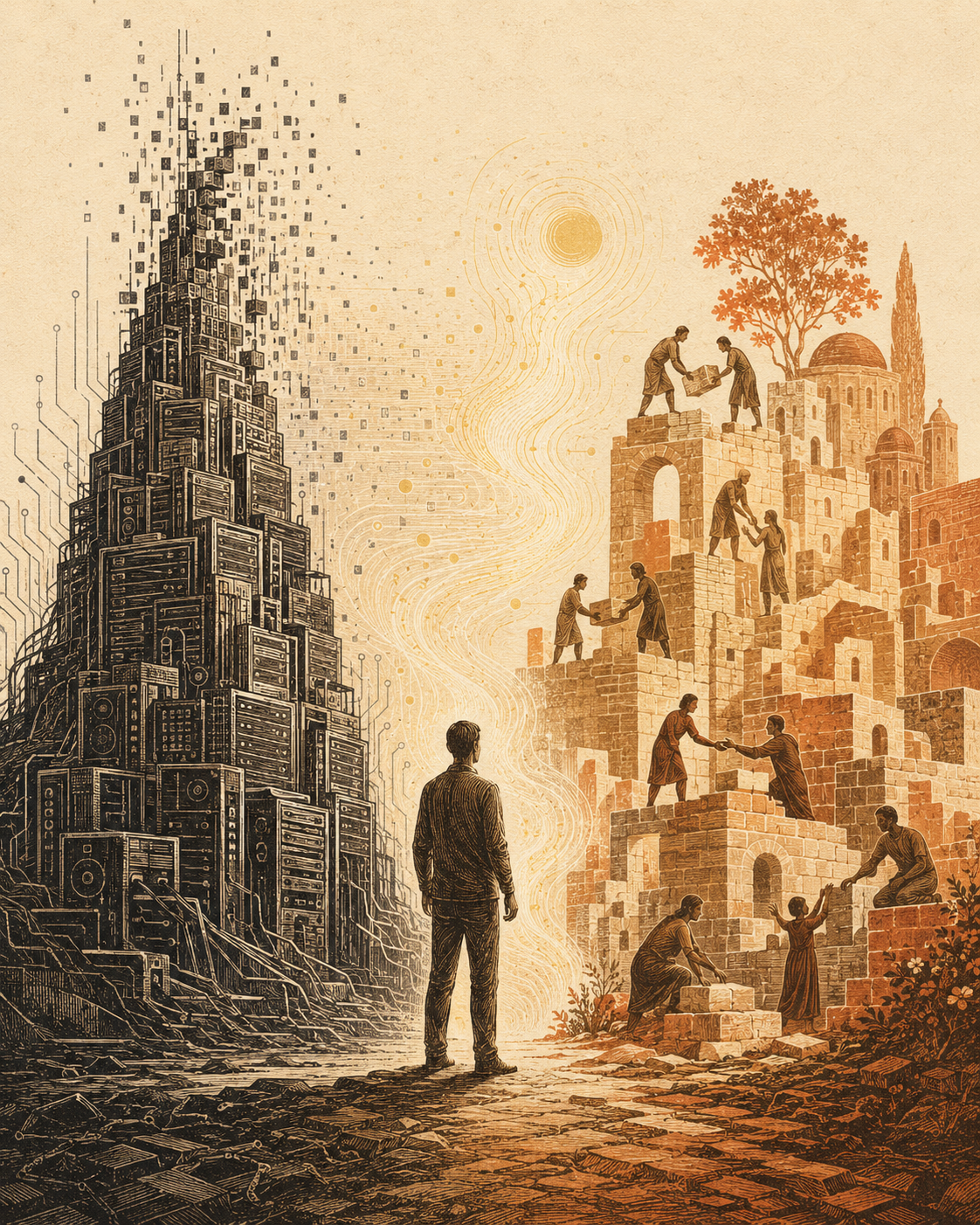
An encyclical on AI
On 15 May 2026, the 135th anniversary of Rerum Novarum, Leo XIV signs Magnifica Humanitas: the first encyclical entirely devoted to artificial intelligence. The gesture is not a casual one. By taking the name of Leo — the pope who, in 1891, confronted the res novae of the industrial revolution — the pontiff draws an explicit parallel: AI is, for our time, what the machine was for his. A second social question opens, of the same magnitude as the first.
The title already states the thesis. Faced with a technology that imitates thought, simulates care, and reconfigures desire itself, the primary stakes are not regulatory: they are anthropological. What the encyclical seeks to safeguard is the grandeur of humanity — not the power of means, but “the care that a civilization is capable of offering.”
Why this dossier
The Awen Project holds that what is called the “AI revolution” is in reality a civilizational transition. Magnifica Humanitas arrives, from a wholly different tradition, at a neighbouring diagnosis: we are not passing through a period of changes, but a change of era. Bringing these two readings into dialogue — one theological, the other rooted in the Awen imaginaire — is part of the work of the circles: setting into resonance the traditions that modernity had separated.
This dossier gathers four entries, ranging from the closest to the text to the most interpretive:
- The full text, in an interactive edition — chapter index, paragraph-by-paragraph navigation (§) and dedicated search.
- The line of argument — a faithful, neutral reconstruction of the encyclical’s reasoning, paragraph by paragraph.
- The thematic synthesis — a mapping of the text reorganized by axes, with a focus on AI.
- The Awen essay — A threshold, not a tool: the encyclical placed in perspective within the intellectual environment of the Project.
How to read
The three commentaries refer back to the text through §n markers pointing to the paragraphs of the encyclical. The full text serves as their common anchor: one can therefore read an argument, then jump to the exact paragraph that grounds it. Nothing requires beginning at the beginning — the essay reads on its own, the line of argument serves as a thread, the full text as a reference.
In this dossier
- Source text The full text The full text of Leo XIV's encyclical (Rome, 15 May 2026), in an interactive edition: a table of the five chapters, paragraph-by-paragraph navigation (§) and a dedicated search. The primary source of the dossier.
- The argument The argument A faithful reconstruction of the encyclical's reasoning, following its thematic structure. This text sets out what Magnifica Humanitas argues and how it chains its theses — without analysis or criticism. The §n references point to paragraphs of the encyclical.
- Synthesis The thematic synthesis A complete mapping of the text (245 §), reorganised by thematic axes rather than chapter order, with a focus on artificial intelligence. The first building block of an analytical framework. The §n references point to paragraphs of the encyclical.
- Essay The Awen essay An interpretive essay placing the encyclical in the intellectual context of the Awen Project: why AI, among all techniques, warrants the word 'threshold,' and why the proposed remedy is itself of an unexpected order — interior. The §n references point to paragraphs of the encyclical.